Science
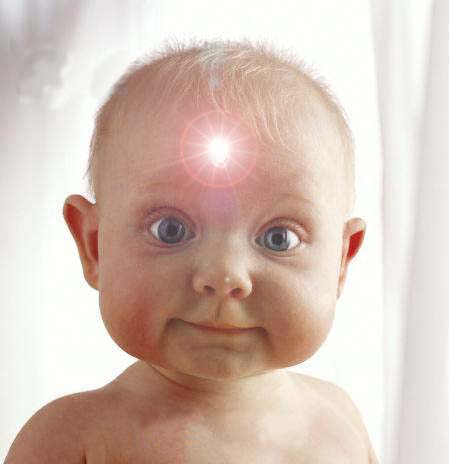
The human body has another physical or "3rd" eye whose function has long been studied. It is the pineal gland and is believed by some to have mystical powers. Many consider it the spiritual 3rd eye, our inner vision, and was described as the seat of the soul by the philosopher Descartes.
The 3rd eye is the said to be the observer of reality.The pineal gland is about the size of a pea, and is in the centre of the brain in a tiny cave behind and above the pituitary gland, which lies a little behind the root of the nose.
The gland weighs little more than 0.1 gramme and, activated by light, it controls the various biorhythms of the body. It works in harmony with the hypothalamus gland that directs the body's thirst, hunger, sexual desire and the biological clock that determines our ageing process.
The pineal gland also secretes melanin during times of relaxation.In some lower vertebrates the epiphysis cerebri (pineal gland) has a well-developed eye-like structure; in others, though not organized as an eye, it functions as a light receptor and is considered by some to be the evolutionary forerunner of the modern eye.
The pineal gland is large in children, but shrinks at puberty. It appears to play a major role in sexual development, hibernation in animals, metabolism, and seasonal breeding. In humans it affects circadian rhythms, sleep patterns (melatonin levels increase at night), and is implicated in seasonal affective disorder. The abundant melatonin level in children is believed to inhibit sexual development. When puberty arrives, melatonin production is reduced.
The symbol of the eye can be found on the American dollar bill.